

Experts:

December 6, 2024
Introduction
Across the United States, population growth in younger demographic groups has slowed over the last two decades. This has resulted in older age groups growing in share of workforce, population, and economic impact. Iowa has been experiencing these trends at accelerating rates. Yet not all employers are prepared for this shift in labor force composition.[i] Preparing them is crucial for ensuring a smooth transition into a new normal of older Iowans contributing to the workforce for longer. This report quantifies the extent of this demographic shift in Iowa and outlines possible solutions moving forward.
Key Findings
- Iowans aged 55 to 64 have disproportionately exited the labor force. This age group reported a current labor force participation rate 7.5% lower than in December 2019. The next highest decline was 0.52% lower for 65 and older.
- In 2023, Iowa ranked 2nd in highest percentage of its population over the age of 65 (24.4%). This is two spots higher than in 2000 (14.9%).
- According to AARP, Iowans over 50 are expected to contribute 43% or $258 billion to GDP and 41% or $21.5 billion to state and local taxes by 2050. This is up from 42% and 38%, respectively.
- Iowa’s workforce can benefit from an expansion of existing programs and tax incentives that reduce barriers to entry for workers and ease training costs for businesses.
Iowa’s Post-Pandemic Labor Market Demography
Iowa has an aging population that will play an increasing role in Iowa’s workforce and economy in the coming years. The Census Bureau estimates that in 2030, Iowans over 54 will compose 41.1% of the working age population, nearly 12 percentage points higher than in 2000. Younger working-age Iowans are also leaving the state. The Census Bureau projects that 13% of the working population under 54 from 2000 is expected to leave Iowa by 2030.[ii] This indicates a clear demographic shift towards older Iowans slowly replacing younger Iowans in population, labor force participation, and as a major contributor to the economy. Although Iowa is not unique in experiencing this dynamic demographic change, the pandemic and other economic trends have accelerated this shift in the labor market.
Iowa’s labor market is poised for an unprecedented shift in labor force demography. In 2000, Iowa ranked 4th highest in percentage of its population over the age of 65 (14.9%). The Census Bureau’s projections for 2030, which were published in 2005, changed Iowa’s rank to 12th highest with this older demographic increasing to 22.5% of the state’s total population. Iowa’s current demography is already ahead of these 2030 projections. As of 2023, Iowa ranked 2nd highest with 24.4% belonging to this group.
This major shift is largely attributable to Iowa’s shrinking 55 to 64 workforce following the pandemic. Table 1 displays the percentage change in number and share of the workforce before and after the pandemic. It focuses on two age categories, 55 to 64 and those over 65, to visualize the stark shift in worker composition.
Table 1. Change in Level of Employment and Share of Labor Force for Ages 55 to 64 and 65+, 2010 to 2023
|
|
Percent Change in Number of Employed (55 to 64) |
Change in Labor Force Share (55 to 64) |
Percent Change in Number of Employed (65+) |
Change in Labor Force Share (65+) |
|
2010 to 2019 |
24.71% |
7.6% |
53.01% |
3.8% |
|
2020 to 2023 |
-16.07% |
-3.2% |
28.83% |
2.9% |
Source: Bureau of Labor Statistics
In the decade leading up to the pandemic, both level of employment and share of labor force grew significantly for both age categories. After the pandemic, workers 55 to 64 disproportionally exited the labor force while those over 65 continued to grow nominally and as a share of the total labor force. The workforce has substantially shifted towards a larger, older workforce in the last few years.
Labor force participation rates (LFPR) also provide a crucial insight into how active certain demographics are in the labor market. Figure 1 visualizes the latest Census Bureau microdata on post-pandemic LFPR, available through IPUMS-CPS. The figure separates the data by four age demographics and shows the change in LFPR from December 2019 to the latest 2024 data.
Figure 1. Change in Iowa Workforce Participation Rate for Ages 55-64 since December 2019
Lingering effects of the pandemic on Iowa’s older workforce have been especially pronounced for workers aged 55 to 64. In 2024, this age demographic’s labor force participation rate (LFPR) was still 7.54% lower than its December 2019 rate. The other three age categories listed in figure 1 were less than 1% lower than their 2019 rates, indicating a stark reminder of the pandemic’s long-lasting impact on Iowa’s mature population.
While Iowa continues to adapt to major shifts in its labor force and population composition, the rest of the United States faces similar challenges. Recent projections from the Bureau of Labor Statistics (BLS) published in August 2024 shed light into this trend at the national level. Figure 2 visualizes the share of population and labor force of all working age demographics across four decades, starting in 2003 and ending in projected 2033.
Figure 2. Share of Population and Labor Force by Age Demographic Category in the United States, 2003 to projected 2033
The BLS report estimates the share of Americans over 54 in the labor force is expected to grow to 23.9% in 2033—0.9 points higher than in 2023.[iii] Simultaneously, this demographic’s LFPR is expected to decline by 1.2%. This is despite a 3.3% increase for Americans between 55 to 64, 3.5% increase for 65 to 74, and 1.9% increase for 75 and older. LFPR among Americans over 55 is expected to fall even though more people will participate due to the population growth of aged 75+ outpacing the other categories. Essentially, those 55 to 64 are expected to drop out of the labor force at a greater rate than those 65 and older, pushing the burden of labor participation onto the nation’s more mature population. Figures 5 and 6 in the appendix provide a more detailed breakdown of the labor force size and the labor force participation rate for each of these age groups.
Economic Contributions of Iowa’s Aging Workforce
As Iowa’s population continues to age, older Iowans are set to have an even greater impact on the state’s economy. Gross domestic product, tax contributions, and overall economic growth will become heavily influenced by this demographic’s economic productivity. The American Association of Retired Persons (AARP) has done extensive analysis on this looming demographic shift and the subsequent economic impacts of older Americans on state economies. Their analyses show evidence for why Iowa needs to address this inevitable demographic shift.
According to a 2018 AARP study, “The Longevity Economy Outlook: Iowa,” the 50 years and older population will continue to drive economic growth for the next 30 years.[iv] Using Regional Economics Models, Inc. (REMI), AARP found that elderly Iowans will continue to fuel extensive economic growth over the next three decades. Figure 3 visualizes the economic contributions of elderly Iowans on GDP and tax contribution in 2018 and estimated 2050 projections.
Figure 3. Iowa’s 50+ Age Demographic’s Economic Contributions
The AARP study found in 2018 Iowa’s 50 years and older population contributed $86 billion towards the state’s total Gross Domestic Product (GDP), equivalent to 42%. In the same year, this population’s market activities supported $6.3 billion in state and local taxes, 38% of total taxes. The economic impact of the aging workforce is expected to increase to $258 billion or 43% of GDP and $21.5 billion or 41% of state and local taxes by 2050.
Even though labor participation of Iowa’s aging workforce is expected to decline by 2033, this subgroup will continue to impact the state’s economy as it continues to delay retirement. An analysis conducted by Changing the Narrative, an organization with a nationwide initiative to end ageism, estimated the cost of delayed retirement in Colorado. This can provide an estimate of the magnitude of economic impact by older workers in Iowa. The report found that if 5% of Coloradans over 65 delay retirement until 75, they could contribute an additional $298 million in spending each year to the state’s economy—or $2.98 billion over the decade.[v] While it’s not clear the exact extent to which delaying retirement impacts Iowa’s economy, the older workforce nonetheless contributes substantially and with great magnitude. According to the AARP study, in 2018 households with Iowans 50 years and older were responsible for 58 cents of every dollar spent but were only 36% of total population. By 2050, when the 50 years and older population accounts for a projected 40% of the population, they will also account for 61 cents of every dollar spent, a 5% increase.[vi] The economic contributions the 50 and older population provides are significant and will only grow in the future.
The Path Forward: Policy Considerations to Catalyze Change[1]
Many businesses remain unaware of the accelerating shift in age composition among available workers.[2] This is a sentiment echoed by 64% of American adults over 50 who believe older workers faced some sort of discrimination in the workforce.[vii] Whether these implicit biases exist in the hiring process or employers and society are slow to recognize the cultural change of older adults who want or need to work longer, older adults are facing unnecessary roadblocks. If this continues, these issues could directly harm the outlook of Iowa’s labor market by disincentivizing participation and productivity among older Iowans. More importantly, without added support from employers, older workers will struggle to receive proper training on relevant skills and knowledge needed to succeed. As labor composition continues to trend towards a larger, older workforce, employers will benefit by recruiting, retaining, and accommodating this older demographic.
This section outlines options for Iowa. It highlights the steps Iowa could take to improve the workplace environment for older Iowans and their employers. Suggestions and analyses are separated into three major topics. The first three subsections explore existing public policies and programs in Iowa that could be expanded. This includes existing programs, recent legislation, and tax incentives. The following subsection discusses federal programs that could be adapted at the state level. The final subsection considers programs from other states and countries that could be adapted for implementation in Iowa. While CSI does not advocate or take positions on specific legislation, Iowa business leaders and policymakers may reference this section as they consider options to prepare for the evolving labor market.
Expanding existing public policies in Iowa
Businesses are not always equipped with the information necessary to keep up with labor market shifts. Many lack convincing resources with incentive to grow their older workforce. However, the state has developed programs to help. In 2023, the Iowa Department on Aging aimed to promote business-friendly resources through a grant for the Age Inclusive Management Strategies (AIMS) initiative—which involved a partnership between the University of Iowa and the Transamerica Institute.[viii] The AIMS initiative focuses on assisting employers in recognizing the ongoing demographic shift, understand existing myths and stereotypes about older workers, and exploring or redesigning benefits, policies, and practices to hire and retain an older workforce. Thousands of Iowa businesses were invited to participate in the free program. Of these, over 100 went through the onboarding process with approximately three dozen engaging to expand opportunities for their older workforce. Continuing to expand this program throughout the state can prove beneficial.
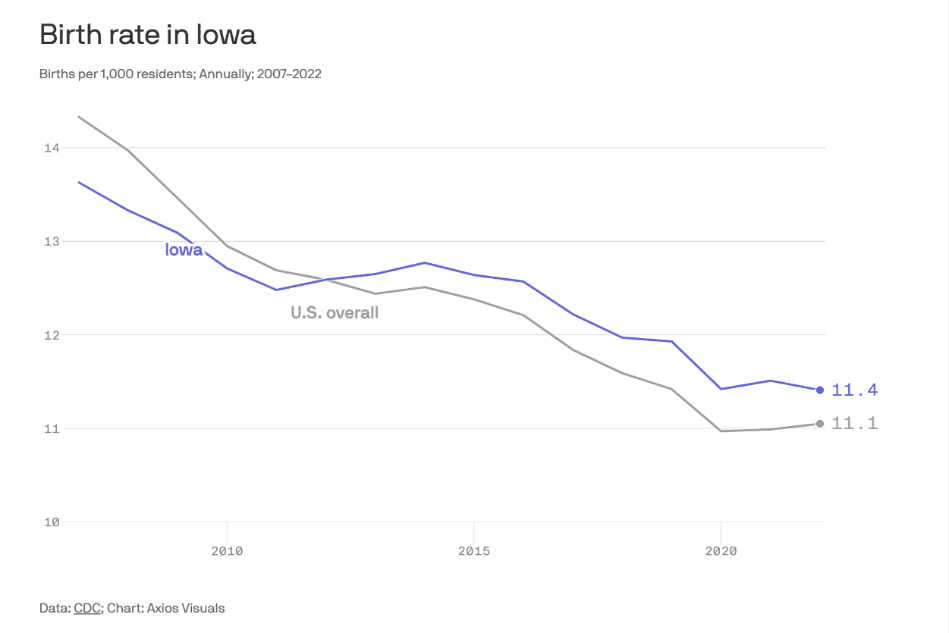
Lingering issues for post-employment assistance persist despite these efforts. Specifically, retirement planning can be difficult for many older workers; not everyone can predict how much wealth is needed to comfortably retire. To help address this, Iowa created the Iowa Solutions for Aging with Independence and Longevity (IA SAIL) project. This program collaborates with government agencies, community partners, and nonprofits to develop a Multisector Plan for Aging (MPA), which addresses aging-related issues. While the focus of most multisector plans on aging is on health and long-term care, Iowa’s MPA aims to reframe longer lifespans as a positive economic opportunity for extended engagement in the workforce, which ultimately leads to healthier lives and a more secure retirement. Moving forward, having a robust work strategy within the MPA is critical. The MPA should include demographic analysis of all ages in the workforce with a keen eye toward the material increase in the aging population coinciding with a forty-year decline in birthrates. Alongside this information would be a general analysis of what the average individual needs to have a secure financial retirement, the current progress generations are making in meeting that target, and what supporting resources are required to reach that target. Ensuring Iowa is prepared to encourage and support lifelong training, education, work, and retirement-security is critical for sustaining a growing economy.
Figure 4. Birth rates in Iowa, 2007 to 2022
Source: Axios Des Moines
Recent legislation in Iowa
Iowa’s House of Representatives has also begun addressing these demographic shifts. Bills relating to retirement income tax, retaining Medicaid benefits, and retirees returning to the workforce have been introduced or passed in recent years. Altogether, these new legislative bills aim to promote financial stability for older Iowans and encourages working without unnecessary barriers.
House File 2317 was signed into law in March 2022 and included a provision to exclude retirement income from Iowa taxable income for certain taxpayers in 2023.[ix] This bill eliminated the tax penalty on retirement income for older Iowans in the workforce, essentially easing the financial burden on older adults who wished to keep working.
House File 2612 was signed into law in March 2024 and will reduce barriers to entry for retired teachers returning to the workforce.[x] The bill will be effective until June 2027 and allows retired teachers to return to work full-time without losing their retirement benefits under certain conditions. It effectively shortened the required waiting period for retired licensed teachers from four months to one month and does not apply a retirement pay penalty for teachers who fall in that window. This legislation is designed to encourage experienced, older educators to rejoin the workforce to address ongoing teacher shortages.
House File 2589 is a case of proposed legislation that failed to progress but is expected to be reintroduced in the next session.[xi] In a world where financial security in retirement is challenging due to longer lifespans and health developments of chronic conditions, improving opportunities for people who want and choose to work is critical. In some sense, this bill attempted to do so. The Medicaid Work Without Worry bill aimed to help Iowans with disabilities continue working without the risk of losing essential Medicaid benefits. The bill’s design improved the existing Medicaid for Employed People with Disabilities (MEPD) program by removing certain barriers that discourage disabled individuals from working more hours or accepting higher wages. Additional key provisions of the bill included no age cap, raising the income limit to 450% of the federal poverty level, and providing six-month continuation of benefits for individuals who temporarily lose employment. While this bill focuses on people with disabilities, it does encompass disabled older adults and could be adjusted to address Iowa’s mature population. Reintroducing a similar bill in future legislative sessions could provide significant benefits for older workers.
Additional tax incentives in Iowa
Additional changes to the tax code could also motivate businesses to hire more older Iowans. Currently, Iowa Workforce Development (IWD) manages the Work Opportunity Tax Credit (WOTC), which incentivizes employers to hire individuals from specific groups with employment barriers. These groups include veterans, ex-felons, summer youth employees, the long-term unemployed, and recipients of Temporary Assistance for Needy Families (TANF), Supplemental Nutrition Assistance Program (SNAP), and Supplemental Security Income (SSI). Although WOTC does not specifically target older adults, groups like long-term unemployed individuals and SSI recipients may include older workers. Broadening WOTC eligibility to include adults 65 and older would benefit employers providing supplemental training to older job seekers through tax credits. Iowa employers can earn up to $2,400 in tax credits per eligible hire. Although a simple change, it could propel the needed incentive towards more employment opportunities.
Implementing federal workforce training and resources
Curtailing workplace biases through educational programs could promote confidence, productivity, and higher labor force participation among prospective and existing workers. Existing state and federal programs, like the Aging Workforce Initiative, American Job Centers, and Area Agencies on Aging, could be pertinent to resolve skill and resource deficiencies for existing and unemployed Iowans.
The Aging Workforce Initiative (AWI) was a program funded by the U.S. Department of Labor’s Employment and Training Administration that proved most beneficial to current workers.[xii] The program used grants to help both employers and employees adapt to the shifting workplace needs. Starting with the employer, AWI aimed to build a better capacity that accommodates older individuals transitioning into the workforce. This largely involved providing suitable training environments for older workers. This allowed older workers to develop relevant skills and knowledge specifically for their work. The overall intent was to help employers more easily assist with the needs of the aging workforce, specifically workers 55-years and older. Companies selected for participation received $1 million grants and were responsible for targeting needy older workers with training techniques, self-employment opportunities, and enhancing existing skills. Iowa can reference and expand on this program to better prepare employers for the future.
A hypothetical AWI program could be funded and implemented by the state of Iowa and focus on training and education for both older adults and employers. The grants would be distributed to rural, urban, and suburban communities throughout the state to ensure all areas are properly involved. The end goal of this program would be two-pronged. First, to equip older adults with the ability to evolve and adapt to changing skill sets and knowledge needed to work. Second, to equip employers with the capacity to train and accommodate older workers into their workforce. This will ultimately expand the overall talent pool for employers to draw from, benefiting both older workers and employers.
Resources for unemployed older adults are also essential to ensure a strong workforce in Iowa. American Jobs Centers (AJCs) are a useful federal resource that currently assists a variety of unemployed Americans re-enter the workforce. AJCs are funded by the Workforce Innovation and Opportunity Act (WIOA) and are designated specifically for job training, employment services, and related support. These centers typically prioritize serving those on unemployment, but in 2014, their mission expanded to include other groups, such as people with disabilities, veterans, older adults, dislocated workers, low-income individuals, and youth.
Despite this broadened mission, no additional funding was provided to connect with the broader community. Dedicating federal or state dollars to specifically support outreach to older adult job seekers could drive more traffic through these centers. Allowing older adults to more easily tap into AJCs opens access to upskilling, reskilling, and nextskilling programs, as well as resume and interview preparation. This better prepares them to find a job and/or make a career transition. Iowa could benefit from expanding on the existing program to specifically address older workers’ needs.
Another way to connect older Iowans to relevant employment resources could be to foster partnerships between AJCs, Area Agencies on Aging (AAA) and local senior centers. AAAs are nonprofit agencies designated by the state to address the needs of older people.[xiii] Iowa currently has six of these agencies, which are funded under the Older Americans Act and can support older adults seeking work.[xiv] Establishing a formal partnership between all three of these actors could support older adults seeking work. Thankfully, Iowa does not need to start from scratch; Pennsylvania has tried something similar with its Community Access Points (CAP) pilot program. The CAP project focused on improving access of training services and job availability information via meeting in common areas. CAP locations included libraries, faith-based organizations, and senior centers. Iowa could benefit from implementing a similar partnership between these organizations and allowing easier access to essential workplace resources.
Public grants to adapt from other states and countries
Many jurisdictions use public grants to encourage and support the hiring and retention of older adults in the workforce. Table 1 outlines three initiatives aiming to do so in Singapore, Colorado, and Los Angeles. These places have developed publicly funded programs, which Iowa could adopt.
Table 2. Out-of-state programs to adapt in Iowa
In 2013, Singapore launched a public grant program known as WorkPro. The program was later enhanced in 2016 to implement age inclusive workplaces, practices, and training.[xv] This is done through three grant options: the Age Management Grant, the Job Redesign Grant, and the Work-Life Grant. The options incentivize employers to accommodate the workplace for older populations. Actions could include improving well-being, health, and safety, job redesign, and flexible help for existing managers, employees and leadership to better understand the demographic shift. According to Josephine Teo, Singapore’s Minister of Manpower, in the first four years of existence, the WorkPro Program benefitted over 3,400 companies employing about 368,000 workers.[xvi]
Another grant opportunity involves the Workforce Innovation Opportunity Act (WIOA) and its annual state funding. Under WIOA, governors are authorized to reserve up to 15% of their state’s total WIOA Title I formula funds for statewide activities. These funds, also called the “Governor’s Reserve,” are allocated from the Youth, Adult, and Dislocated Worker programs. The reserved funds can be utilized for various statewide employment and training initiatives, including capacity building, technical assistance, and innovative workforce development strategies. In Colorado, the Colorado Workforce Development Council (CWDC) dedicated several hundred thousand dollars from the Governor’s Reserve funds to create a Talent Equity Agenda on employing people of color.[xvii] Iowa might consider pursuing a similar use of this funding to addresses the needs of older workers.
The City of Los Angeles took a different approach, opting to create AdvantAGE LA: A Blueprint for Employing, Retaining, and Advancing Older Workers Across LA. The full report was released on August 9th, 2024 and will begin implementation in 2025.[xviii] Through a collaboration of dozens of stakeholders, funding from the City, and engaging a consulting to spearhead the work, AdvantAGE LA embraces demographic changes and encourages employers to expand their talent pool to incorporate older workers. Iowa could benefit from incorporating a similar styled initiative at the local level. Through a combination of stakeholder backing and local funding, local businesses could garner easier access to resources necessary to adapt to the shifting demographics.
Bottom Line
Age composition in the labor force is shifting in post-pandemic America, and Iowa is experiencing this trend at an accelerated pace. Workers over the age of 50 are exceeding expectations in labor force size and are projected to triple their economic contribution to Iowa’s GDP in the next three decades. Yet this shift is not necessarily an issue. Longer workspans can prove beneficial to society by reducing the need for state and federal Medicare programs, which have ballooned in governemnt cost in recent years.[xix] Additionally, about half of Americans between 55 and 66 having no retirement savings and no ability to retire.[xx] Supporting an older workforce will prove fruitful both for older Iowans and the broader economy. Whether by expanding existing programs or adopting policies and programs that have seen success in other jurisdictions, Iowa policymakers and employers must prepare for the inevitability of an aging workforce.
Appendix
Figure 5. Total Labor Force Size and Participation Rate, All Iowans Aged 55-64, 2003 to 2023
Figure 6. Total Labor Force Size and Participation Rate, All Iowans Aged 65 and over, 2003 to 2023
[1] A special acknowledgement to Karen Brown, the CEO and Commissioner of iAging and the Colorado Commission of Aging (CCOA). She currently Chairs the CCOA Workforce Committee and is the Past Chair of the Strategic Action Planning Group on Aging, for her contributions to this section of the report.
[2] Businesses are focused on today’s challenges of filling positions, supporting the existing workforce, and growth. Few have the luxury of time to do longer term strategic planning for the workforce which would allow them to look more closely at the accelerating shift in age composition. Thankfully, employers and society are slowly adapting to longer lifespans through providing opportunities for interested older adults seeking to stay in the workplace longer, albeit in varying capacities—part time, gig, seasonal, etc.
[i] Robert Sheen, “Prospects Are Bright For Older Workers—And Employers Who Hire Them,” Forbes Human Resource Council, Forbes, March 15, 2024, https://www.forbes.com/councils/forbeshumanresourcescouncil/2024/03/15/prospects-are-bright-for-older-workers-and-employers-who-hire-them/.
Note: According to an AARP survey of employers from OECD countries, roughly 4% have implemented programs that integrate older workers into their workforce. Only a quarter of them are “very likely” to explore doing so in the future.
[ii] Iowa Data Center, “Interim Population Projections Change in Total Population and Selected Age Groups in Iowa: 2000 to 2030,” State Data Center of Iowa, 2005, https://www.iowadatacenter.org/browse/projections.html.
[iii] Kevin S. Dubina, “Labor force and macroeconomic projections overview and highlights, 2023–33,” Monthly Labor Review, U.S. Bureau of Labor Statistics, August 2024, https://doi.org/10.21916/mlr.2024.14.
[iv] AARP, “The Longevity Economy Outlook: Iowa,” 2023, https://www.aarp.org/content/dam/aarp/research/surveys_statistics/econ/2020/longevity-economy-outlook-iowa.doi.10.26419-2Fint.00044.016.pdf
[v] https://changingthenarrativeco.org/wp-content/uploads/2021/02/Benefits-of-Older-Individuals-in-the-Workforce-3-Illustrative-Examples_20191223.pdf.
[vi] AARP, “The Longevity Economy Outlook: Iowa,” 2023, https://www.aarp.org/content/dam/aarp/research/surveys_statistics/econ/2020/longevity-economy-outlook-iowa.doi.10.26419-2Fint.00044.016.pdf
[vii] Lona Choi-Allum, “Age Discrimination Among Workers Age 50-Plus,” AARP Research, July 2022/January 2024, https://doi.org/10.26419/res.00545.001.
[viii] Transamerica Institute, “Age-Inclusive Management Strategies,” https://www.transamericainstitute.org/initiatives/age-inclusive-management-strategies.
[ix] An Act Relating to State Revenue and Finance By Modifying Individual Income Tax Rates and More, HF 2317, State of Iowa 89th General Assembly https://www.legis.iowa.gov/legislation/BillBook?ga=89&ba=HF%202317.
[x] An Act Relating to Education and More, HF 2612, State of Iowa 90th General Assembly, https://www.legis.iowa.gov/legislation/BillBook?ga=90&ba=HF%202612.
[xi] An Act Relating to Medicaid-Related Programs and Services, HF 2589, State of Iowa 90th General Assembly, https://www.legis.iowa.gov/legislation/BillBook?ga=90&ba=HF%202589.
[xii] Deborah Kogan, et al., “The Evaluation of the Aging Workforce Initiative (AWI) Interim Report,” Social Policy Research Associates, August 2012, https://www.dol.gov/sites/dolgov/files/ETA/publications/ETAOP_2013_19_Interim_Report.pdf.
[xiii] Iowa Association of Area Agencies on Aging, “Iowa Area Agencies on Aging (I4A),” Aging Resources of Central Iowa, 2024, https://www.agingresources.com/about-us/iowa-area-agencies-on-aging-i4a/.
[xiv] “Older Americans Act,” USAging, 2024, https://www.usaging.org/olderamericansact
[xv] Ministry of Manpower, “Written Answers by Mrs. Josephine Teo, Minister for Manpower, to Parliamentary Question on WorkPro Grants,” Ministry of Manpower Newsroom, May 18, 2018, https://www.mom.gov.sg/newsroom/parliament-questions-and-replies/2018/0518-written-answer-by-mrs-josephine-teo-minister-for-manpower-to-parliamentary-question-on-workpro-grants.
[xvi] Ministry of Manpower, “Written Answers by Mrs. Josephine Teo, Minister for Manpower, to Parliamentary Question on WorkPro Grants,” Ministry of Manpower Newsroom, May 18, 2018, https://www.mom.gov.sg/newsroom/parliament-questions-and-replies/2018/0518-written-answer-by-mrs-josephine-teo-minister-for-manpower-to-parliamentary-question-on-workpro-grants.
[xvii] “Talent Equity Agenda,” Colorado Workforce Development Council, 2024, https://cwdc.colorado.gov/talent-equity-agenda
[xviii] Workforce Development Board, “AdvantAGE LA: A Blueprint for Employing, Retaining, and Advancing Older Workers Across LA,” City of Los Angeles, August 2024, https://www.wiblacity.org/index.php/about/reports.
[xix] Juliette Cubanski and Tricia Neuman, “What to Know about Medicare Spending and Financing,” Kaiser Family Foundation, January 19, 2023, https://www.kff.org/medicare/issue-brief/what-to-know-about-medicare-spending-and-financing/.
Note: Medicare benefit spending is “projected to increase from $829 billion in 2021 to $1.8 trillion in 2031,” and grow as a share of the federal budget from 10.1% to 17.8%.
[xx] Brittany King, “Those Who Married Once More Likely Than Others to Have Retirement Savings,” U.S. Census Bureau, January 13, 2022, https://www.census.gov/library/stories/2022/01/women-more-likely-than-men-to-have-no-retirement-savings.html.