


September 14, 2022

Legislative Council Draft: Prop 123- Dedicate Revenue for Affordable Housing Programs
Prop. 123 Ballot Text
By Race (nar.realtor)
Executive Summary
Colorado has rapidly become one of the most expensive states to live in the country. High population growth combined with a sustained underproduction of new housing has led to a highly strained housing market. With an estimated housing unit shortfall between 93,000 to 216,000 units, and the fluctuations in demand amidst the pandemic, the average cost of for sale homes and median rents have skyrocketed.
As tensions rise across Colorado cities in response to housing unaffordability, the urgency to address the housing unit shortfall has stirred the State Legislature to act. $1.2B
of the American Rescue Plan Act’s one-time funding was allocated towards a myriad of affordable housing initiatives in 2021 alone.
To address the unit production shortfall, Proposition #123
has qualified for the ballot, requesting that Coloradans dedicate 1/10th of 1% of federal taxable income from the State’s General Fund to create Colorado’s first statewide voter initiated affordable housing fund. While the measure does not increase tax rates, the money transferred to the new affordable housing fund will lower future TABOR refunds by an equivalent amount. In years with no TABOR refund, the transferred funds would normally be allocated to other state uses which will require monitoring in future years. Like it or not, Proposition #123 interfaces with the deeply entrenched cultural elements that TABOR presents in the minds of Colorado voters.
It’s not hyperbole to state that Proposition #123 is an ambitious measure that has the potential to drive transformational changes to our Colorado housing market. The measure presents a number of exciting new tools such as:
- A dedicated and permanent affordable housing funding mechanism, 3X the Division of Housings 2021 state allocation, that empowers the state to address the ongoing subsidy needs of affordable housing development[iii]. This is a segment of the demand for affordable rental and home ownership that the non-subsidized market struggles to serve under today’s constraints.
- A Fast Track Approval Policy focused on reducing the elongated, costly housing approval process timelines that are plaguing Colorado local governments. The 90 Day Fast Track Approval Process, a requirement of local government participants, is an evidence-based[iv] mechanism to reduce the overall cost of affordable housing production that if embraced by local governments, has the potential to deliver affordable housing units to market in a far more efficient manner.
- Funding for Land Banking to purchase and hold land via grants and low interest loans helps local governments and developers “attack the cost” allowing a greater percentage of affordable housing projects to “pencil out”[v] across Colorado’s high-cost real estate markets.
- A Tenant Equity Vehicle, which addresses the lack of wealth building opportunities impacting renters whose average net wealth is $8,000[vi] compared to $300,000 for homeowners as of 2021, by providing a means to vest renters in the program’s performance “via funding for a down payment for housing or other related services.”
However, there are challenges the measure presents that require attention.
Stated bluntly, the measure is only as successful as the number of local governments that decide to opt into the program. If the capture rate of local governments is weak, due to any number of reasons, the program will be faced with a multitude of challenges.
- First, is the uncomfortable reality that Coloradans who have voted for the successfully adopted measure could fail to benefit from its investments, due to their local government choosing not to opt in.
- Secondly, if the measure struggles to enroll local governments, the fund may grow larger with each passing fiscal year. With a lack of performance that is subject to fierce scrutiny at the state legislature. Facing competing state priorities for other critical budgetary needs at the risk of lawmakers reappropriating the funds increases exponentially.
- Furthermore, as the program administrator, the Division of Housing within the state Department of Local Affairs, will face intense pressure to be flexible and respond to local government demands with key requirements such as the 3% growth targets and fast track approval process, in order to enroll as many jurisdictions as possible. The pressure to enroll local governments sets the stage for disaggregated, and inconsistent standards across the state, straying from the original intent of the measure, mitigating the value proposition of the measure as written.
Additionally, while the measure does not raise tax rates, it transfers 1/10th of 1% of federal taxable income from the state’s General Fund, to fund affordable housing programs – funding that would normally be earmarked for other uses, the General Assembly's Joint Budget Committee (JBC) must evaluate the program outcomes closely. In the years ahead, the JBC must ensure the measures outcomes are commensurate with the people’s investment, providing the required rate of return as it relates to the measures interaction with other critical state budgetary needs.
To address the challenges the measure presents, and maximize its strengths, proponents, supporters, elected officials and Coloradans alike should consider the following recommendations if the measure passes.
- Address the Potential of a Growing Fund Balance – Institute a Performance Based Cap.
- Address the Risk of Reappropriation – “Re-Bruce” Any Reappropriated Funds.
- Resist Attempts to Loosen the Measures Requirements for Accepting Funds – Stay True to the Measures Value Proposition.
- Resist Hyper Localism – Incentivize Local Governments to Adopt Regional Fast Track Approval Policies.
- Drive Continuous Improvement – Require a Periodic Fund Performance Analysis.
Introduction
Good luck trying to find an affordable home in Colorado, be it for rent or for sale; they simply do not exist. As CSI’s recent Colorado Quarterly Housing Update
starkly illustrates, due to elevated home prices and rising interest rates, the affordability of purchasing a home is at its lowest point in 33 years. As such, it should not come as a surprise that 98% of Coloradans live in a county with an aggregate housing supply shortage, with unit deficit estimates as of 2020 ranging between 93,000 to 216,000; a byproduct of chronic housing production shortfalls following the Great Recession that did not cease until shortly before the COVID19 Pandemic.
While building permits have trended up in Colorado with 2021 delivering a 40% increase over the previous five years, Colorado counties continue to struggle to deliver the housing units required to meet their population’s current and future demands.
Complicating matters moving forward is the contracting American housing market, which in 2022 has seen new single family housing unit production contract by 10.6% across the nation. This is the first decline nationally since 2011. The multifamily segment which includes apartments and condos has experienced an 8.6% reduction per National Association of Home Builders Chief Economist Robert Deitz.
As Coloradans have learned, failing to meet our annual new housing unit targets places significant pressure on our housing market, causing rents and home prices to rapidly eclipse what Coloradans can afford.
As Colorado grapples with our ongoing housing unit shortfall, a reduction in annual housing permits is a significant threat to our state economy and the well-being of our citizens. To address this threat head on, a new housing measure, Proposition #123, will appear on the 2022 statewide ballot. The Proposition proponents state it will deliver the funding to support the creation of 170,000 new affordable housing units over 20 years.
If the measure passes, it will add to the significant affordable housing investments passed by the State Legislature in recent sessions, with over $650 million
allocated in the 2022 session alone.
While funding for affordable housing is a critical need, it alone is not the root cause of our housing unit deficit. The additional critical factor is the systemic issues presented by what Freddie Mac
states is exclusionary local land use, planning and zoning regulations, which the measure does not specifically address.
As many other states have shifted their affordable housing strategies to address exclusionary zoning regulations via statewide housing policy interventions
, the deeply entrenched ethos of local control, home rule governance has stalled the deployment of statewide housing policy interventions here in Colorado. Rather, state policy has focused on a carrot versus the stick approach in this regard, notably via recent legislation like The Department of Local Affairs Innovative Affordable Housing Strategies
which incentivizes local governments to change their entitlement processes in return for access to technical assistance and funding for affordable housing initiatives. This incentive-based approach to addressing the challenges of local entitlement policies remains what Colorado lawmakers and now, the proponents of Proposition #123 are counting on as the most viable solution that will be amenable to all Coloradans. At this moment these policy approaches take the place of the designation of housing entitlement policies as a matter of statewide concern and the subsequent deployment of greater uniformity. It remains to be seen if the current Coloradan dedication to local control housing policy will be a more productive strategy when compared to other states. What is clear is that Proposition #123 requires robust local government engagement.
This herein lies the measures strengths, challenges and ultimate success, first at the ballot box this fall and then if passed, the willingness of Colorado cities and counties to voluntarily opt in to gain access to the funding provided by Proposition #123.
Proposition #123, “Dedicated State Income Tax Revenue for Affordable Housing Programs”: An Overview
What is Proposition #123 and what does it do?
- This measure sets aside 1/10th of 1% of annual tax revenue to fund affordable housing programs – with no cap or sunset.
- This measure requires the creation of 90-day Fast Track Approval policies by participating local governments.
- This measure requires participating local governments identify annual affordable housing development targets of 3% growth per year that must be achieved to maintain eligibility over a three-year commitment cycle.
- This measure defines affordable housing via two factors: household income and housing costs to include utilities. The measure applies to renters earning <60% of the Area Median Income, or homeowners earning <100% of the Area Median Income.
- This measure requires the weighted average cost of all participating project units not to exceed 30% of the households’ income, inclusive of incremental utilities costs.
What Proposition #123 is not:
- This measure does not require local governments to participate – they can choose not to engage the fund if they so desire.
- This measure does not require that local governments change their current land use, planning and zoning policies.
- This measure is not a panacea and, won’t on its own volition, solve the affordable housing unit shortfall impacting Colorado.
To better understand the potential attractiveness of Proposition #123, let’s first look at what Proposition #123 is proposing. The measure asks Coloradans to invest 1/10 of 1% of federal income tax revenue from the State General Fund. It is estimated to collect $290M in fiscal year 2022/2023 for the purpose of affordable housing programs to be administered by The Office of Economic Development and International Trade who will transfer the administration of their share to the Colorado Housing and Finance Authority and the Division of Housing within the Department of Local Affairs. The measure provides funding for a number of dedicated uses across the housing continuum as seen below:
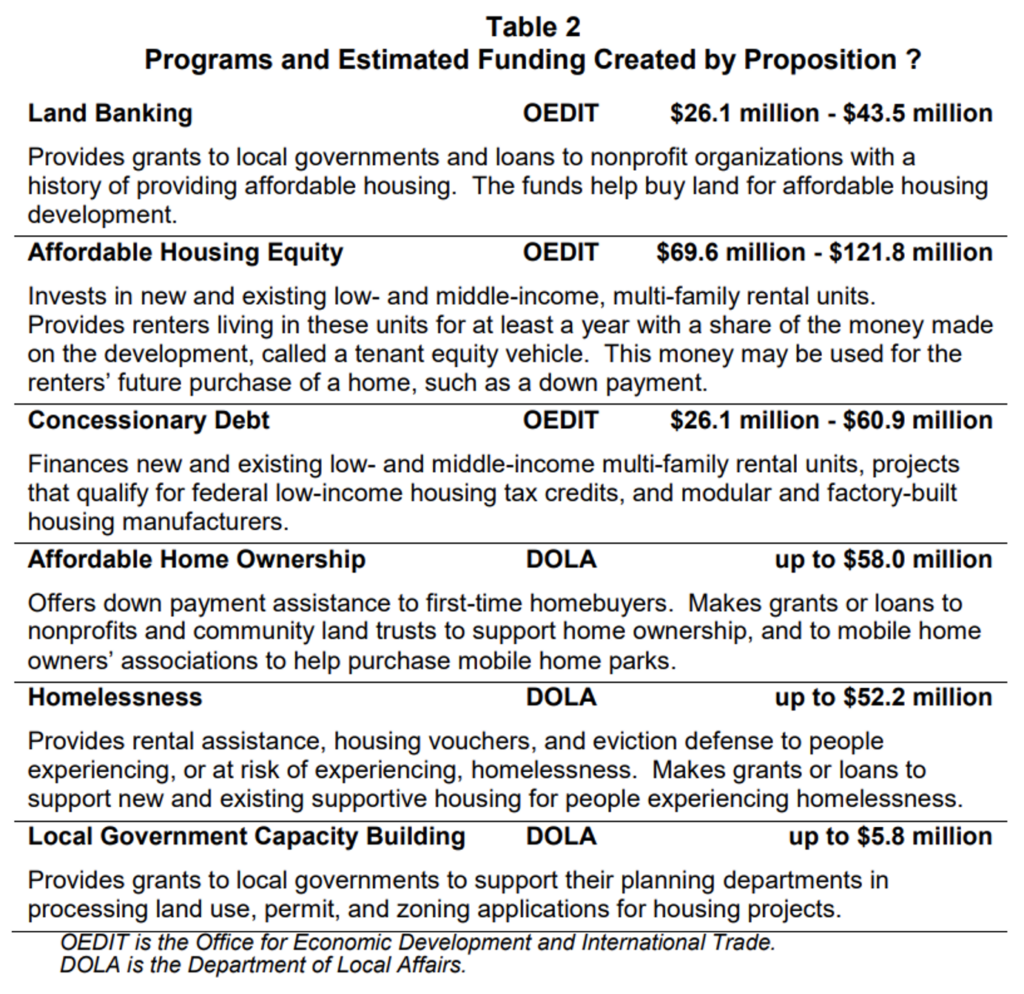
Image Source: Colorado Legislative Council Staff Draft Blue Bool Analysis
Proposition #123’s Strengths
By providing a dedicated funding stream to all major segments of the affordable housing spectrum from homelessness to homeownership, with no sunset, Proposition 123 looks to address all segments of the Colorado affordable housing continuum. Here are several strengths within the measure.
- The Creation of Fast Track Approval Policies
- Housing permitting times are one of the most challenging aspects of developing affordable housing, for both developers and local governments. Time costs money and the longer housing permitting process take, the greater the impact on the cost of the development. A recent James Madison Institute study focused on southern Florida found that permitting delays added $6,900[xiv] to the cost of a typical home. While the decision to include a Fast Track Approval process as a requirement to access the funds is a gamble that we will discuss in detail later in this analysis, reducing housing development approval times is an evidence-based approach to reducing the overall cost of housing development and should be celebrated if achieved.
- Land Banking
- Developing real estate is a costly affair, with the cost of land being a significant barrier to the development of affordable housing. While traditional land banking programs are focused on addressing tax delinquent properties as a means of addressing blight in weak real estate markets, Proposition #123 utilizes land banking as a means to assist local governments and nonprofit developers in the acquisition of land, with patient capital, to allow development in the near future. By providing grants to local governments, such as Public Housing Authorities, and low interest loans to non-profit organizations to acquire and preserve land for the development of affordable housing with a mechanism to allow for the forgiveness of a loan if the land is zoned within 5yrs and permitted for development within 10yrs, the measure provides a vital resource for affordable housing developers to compete for desirable, costly land at a cost basis that can “pencil out” a project that otherwise would not be viable. Providing a mechanism and subsequent funding in this manner is a proven tool utilized to reduce the total cost of a development’s construction and will be a significant strength of the measure if passed.
- Division of Administrative Oversight
- The Division of Administrative oversight between the Colorado Division of Housing and The Colorado Housing Finance Authority positions the fund to accomplish its mission. This division of administrative duties also provides a much-needed A/B test amongst the two entities. This allows lawmakers and leaders the ability to evaluate the effectiveness of administration to best drive continuous improvement with the agencies.
- A Tenant Equity Vehicle
- One of the most innovative and exciting elements of the Proposition happens to be flying under the radar, found deeper in the language of the Initiative: The Tenant Equity Vehicle (TEV). TEV is something unique, and inspirational, which has the potential to change the lives of Coloradans who stand to benefit not only by gaining an affordable home from the program’s investments, but also from the overall fund’s fiscal performance. While the Proposition does not delineate exactly how the TEV will function, the structure as written in the Proposition states: “residents in projects funded by the program for at least one year will be entitled to funding from the program for a down-payment on housing or related purposes.”[xv] This is to be accomplished by capturing “returns on program investments greater than the program’s Proposition investment shall be retained in the program to fund the Tenant Equity Vehicle.” We eagerly await the future announcement of the TEV structure and encourage the drafters to empower direct cash transfers in the form of no less than annual dividends triggered by clearly articulated program goals made available to the public annually.
Proposition #123’s Challenges & Threats
What’s
not
to like about Proposition 123, you ask? Well, not everything about Proposition 123 is rainbows and moonbeams. While the Proposition has many strengths, it makes a few large bets. If they do not play out as forecasted, they could significantly hinder the measures success and introduce material threats – let’s dig in, shall we?
The Taxpayer Bill of Rights (TABOR)
- TABOR Remains Top of Mind for Colorado Voters
- While Proposition #123 is not a tax increase, since it calls to source funds from the State General Fund, the fund will reduce future TABOR refunds by a proportional amount, requiring the measure to address the TABOR dynamic regardless. In a state governed by, and influenced culturally by TABOR[xvi], the Proposition will face headwinds at the ballot box that should not be understated.
- Capture Rate – Will Local Governments Opt-In?
- Stated bluntly, Proposition #123 is only as successful as the number of cities and counties who decide to opt into the program. If the capture rate of jurisdictions is weak, due to any number of reasons, the program will be faced with a multitude of challenges. Thus, setting up an uncomfortable reality where Coloradans who have voted for the successfully adopted measure could be on the outside looking in, unable to benefit from the measures investments due to their local government choosing to not opt-in.
- Risk of Reappropriation
- Consider this plausible scenario: The fund, which has no cap, struggles to enroll local governments. As a result, the fund grows larger each fiscal year. With a lack of outcomes that are subject to fierce scrutiny and critique at the state legislature, while also facing competing priorities for funding from the state legislature, lawmakers could easily and legally reappropriate[xvii] the funds to address other critical state funding needs, be it K-12 funding, infrastructure, etc. Additionally, the risk of reappropriation is amplified due to the funds being TABOR exempt which poses incremental state budget risk. While the measure attempts to safeguard the fund from actions such as this, precedent demonstrates that the legislature has legal solid ground to reappropriate funds as they deem necessary. The proponents believe that lawmakers would be hard pressed to reallocate funds following the strong support and will of the Coloradan voters who passed the measure – but will they?
- Will The Measure Provide Outcomes Commensurate to the People’s Investment?
- The measure exists to help close the gap of affordable housing units across Colorado. To accomplish its purpose, the measure does not raise taxes, rather it transfers 1/10th of 1% of federal taxable income from the State’s General Fund, to fund affordable housing programs, funding that would normally be earmarked for other budgetary uses. This presents the General Assembly’s Joint Budget Committee (JBC) a new dynamic that must be evaluated closely should the measure pass. In the years ahead, the JBC must ensure the measure’s outcomes are commensurate with the people’s investment, providing the required rate of return as it relates to the measures interaction with other critical state budgetary needs.
Proposition #123’s Impact on TABOR
Proposition #123 asks Coloradans to approve a state revenue change and thus is not subject to Colorado’s constitutional revenue limit, commonly referred to as the Taxpayer’s Bill of Rights (TABOR). The measures draft ballot analysis states the TABOR impact as such:
“In years where state revenue exceeds the TABOR limit, the measure reduces the money returned to taxpayers by the amount of income tax revenue that that the measure allows the state to keep. In years where state revenue is below the TABOR limit, the measure does not impact TABOR refunds, but may reduce the amount of money available for the rest of the state budget. In this case, the measure allows the state legislature to reduce part of the new funding to the affordable housing programs to balance the state budget. The state currently expects to return money collected above the limit through at least the 2023-24 budget year.”
Proposition #123’s Impact on Colorado Taxpayers per the draft ballot analysis:
[iii] Capital subsidies for building affordable housing developments – Local Housing Solutions
[iv] Expedited permitting and review policies encourage affordable development | National Housing Conference (nhc.org)
[v] The cost of affordable housing: Does it pencil out? (urban.org)
[vii] Colorado Housing Quarterly Update | Common Sense Institute (commonsenseinstituteco.org)
[viii] Housing Recession Deepens – NAHB
[ix] Solution — Make Colorado Affordable (yeson123co.com)
[x] A new program could help build 16,000 homes in Colorado as part of a bigger $650 million plan | Colorado Public Radio (cpr.org)
[xi] Housing Supply: A Growing Deficit – Freddie Mac
[xii] States can improve housing well-being through thoughtfully designed policies (brookings.edu)
[xiii] Department Of Local Affairs Innovative Affordable Housing Strategies | Colorado General Assembly
[xiv] Assessing the Effects of Local Impact Fees and Land-use Regulations on Workforce Housing in Florida – James Madison Institute
[xvi] TABOR | Colorado General Assembly
[xvii] How Colorado lawmakers closed a $3 billion shortfall to balance the budget and why it led to tears – The Colorado Sun
[xviii] Denver’s housing permit backlog plight | Business | denvergazette.com
[xix] From Conflict to Compassion: A Colorado Housing Development Blueprint For Transformational Change | Common Sense Institute (commonsenseinstituteco.org)