

September 25, 2024
Experts:
Summary and Key Findings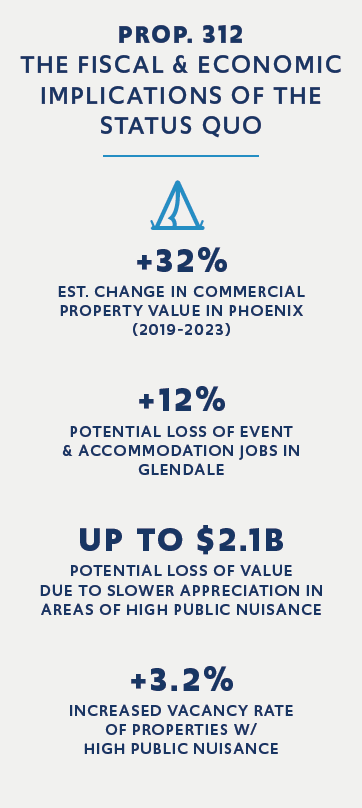
This November, Arizona voters will decide whether to allow property owners a property tax refund to cover reasonable costs associated with unmitigated expenses related to homelessness, vandalism and property crime, and drug use. In order to be eligible for relief, the property owner would have to document the expense, and establish it was a direct result of a city or county government failing to enforce existing laws related to illegal camping, loitering, and other public nuisances.
To assess the impact of an ongoing failure by local governments to unforce existing laws, this report evaluates the economic impacts of the current environment of unmigiated public nuisances, open drug use, and general property crime on commercial property values in the Phoenix area. To do so, the Common Sense Institute (CSI) identified areas of Phoenix that had both a high concentration of measured homelessness and a high incidence of property crime, according to the Point-in-Time count and data from the Phoenix Police Department. Utilizing both commercial real estate analytic and community crime mapping software[1], CSI then identified disparate impacts to these areas relative to the city at large.
Proposition 312 would not restore property owners for this loss in property value (or foregone property appreciation). However, this analysis suggests there may be real and ongoing unmitigated issues with unsheltered homelessness, increased property, crime and other public nuisances affecting values in certain parts of the city. Increased litigation risk and the possibility of tax refunds could encourage increased enforcement and mitigation efforts.
Key Findings
- The status quo is costly. Crime, drug overdoses, unsheltered homelessness, and other public nuisances have risen dramatically in Arizona and the greater Phoenix area since 2019. But the impacts are disproportionate: the problem has become more visible in certain parts of the city, most famously in parts of downtown Phoenix (“The Zone”). This creates a negative economic impact for those parts of the city where local officials have failed to enforce existing laws – while it’s difficult to measure documented mitigation expenses directly, this impact does show up in valuations, vacancy rates, and appreciation.
- Commercial property within areas identified by CSI as affected by unmitigated public nuisances had estimated market rents appreciate at about half the rate of Phoenix as a whole – only 15.7% over the 2019-2023 period (according to the Costar database). This is less than the rate of inflation for the same period, meaning that these properties decreased in real value.
- By this estimate, the impact of the current environment of unmitigated public nuisance in certain, highly concentrated parts of the city has resulted in foregone commercial property appreciation of up to $2.1 billion in lost value.
- Across five properties located in high public nuisance areas studied by CSI, and over the most recent 1-year period reported by LexisNexis, there were an average of 108 reported drug crimes within a half mile, 96 reported burglaries, 26 reported robberies, and ~1.5 reported arsons. This implies effective average criminal activity rates around these locations 3 to 5 times higher than the “expected” level for Phoenix overall.
Homelessness, Crime, and Drugs: A Crisis
Over the past five years, three shared problems have manifested in Arizona – especially in its cities and urban centers. Since 2017, the official count of people experiencing homelessness in Arizona has increased 60%, and in the
greater Phoenix area the count has nearly doubled.[i] Over the same period, the rate of fatal drug overdoses has increased by two-thirds[ii] and fatal opioid-related overdoses have more than doubled[iii]. Crime rates in Arizona ended a three-decade decline around the same time and violent crime is again on the rise.[iv] These three crises came to a head around the same time and are due at least in part to a common factor: changing social attitudes about how society – and in particular law enforcement – should treat homelessness, drug use, and so-called petty or victimless crimes (or crime in general).[v] [vi]
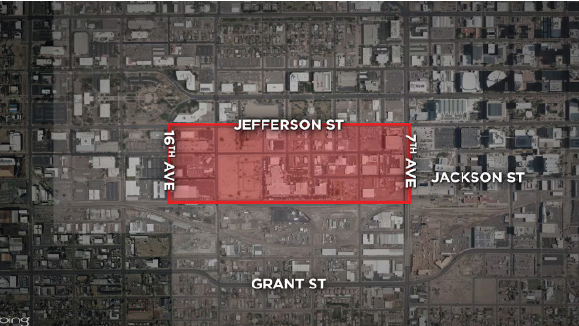
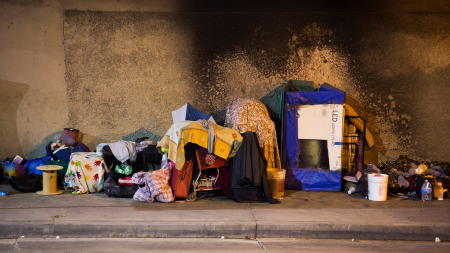
In downtown Phoenix, an area of industrial and light commercial around the state’s largest shelter (Central Arizona Shelter Services, or CASS) has for decades had a transient homeless population associated (at least in part) with movement and activity around the shelter itself. According to a property owner in the area interview by CSI, homelessness-related activity and associated public nuisances would peak annually around the holidays, but a proactive response by Phoenix Police and other city officials would mitigate the issue and the area would return to normal around the start of the new year. Beginning in 2020, according to a lawsuit filed by local business owners, that pattern changed – the encampments became semi-permanent, and the nuisances became more serious.[vii] Abatement efforts by the city changed – law enforcement became less involved, and instead of regularly cleaning out any encampments and personal items in the public right-of-way (sidewalks, etc.) the city began limiting its regular maintenance to the curb line (e.g. the gutters).[viii] According to quotes from city officials at the time, this was done so that personal items (like identification and paper records) weren’t inadvertently thrown away.